

A DISC reading enriched by contemporary psychometrics
The DISC method holds a unique place among behavioural tools. It is easy to understand, easy to communicate and immediately usable in a professional context — yet it is also regularly discussed from a scientific standpoint.
T8® starts from this observation.
We do not treat DISC as a definitive psychological truth, nor as an exhaustive measure of personality. We treat it as a behavioural reading framework, useful when built rigorously, tested statistically and interpreted with care.
Our work is to preserve the clarity of the original DISC model while strengthening it with a modern psychometric approach inspired by personality trait research, notably the Big Five model.
The origins of the DISC model
The DISC model originates in the work of Dr. William Moulton Marston, particularly Emotions of Normal People, published in 1928. Marston developed a reading of human behaviour around observable tendencies that later became the basis for DISC models used in professional contexts.
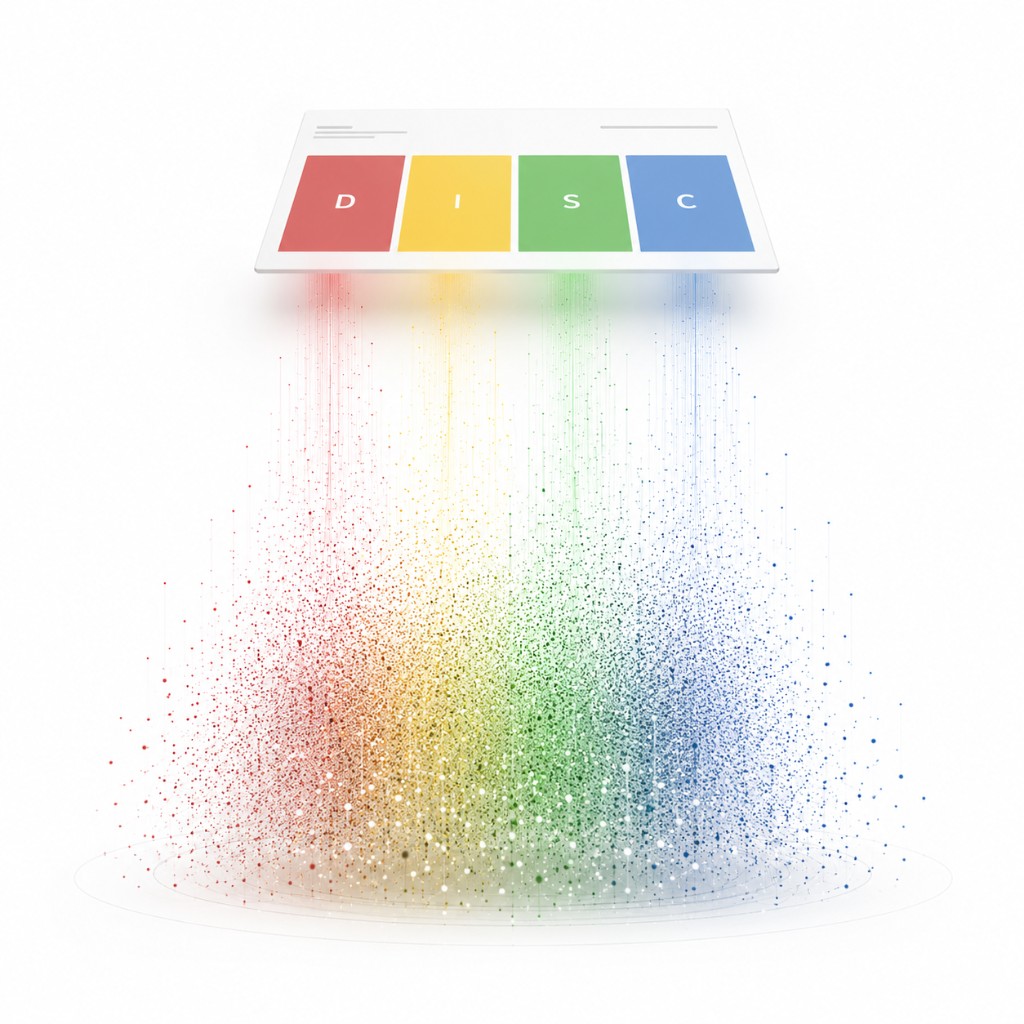
- D — Dominance
- I — Influence
- S — Steadiness
- C — Conscientiousness
These dimensions express behavioural preferences that are easy to understand: relationship to action, others, pace, stability, structure, precision, decision-making and adaptation.
Importantly, Marston did not create a standardised DISC questionnaire as we know it today. Contemporary DISC tools are later developments by different publishers, with varying questionnaires, scoring systems and validation levels.
That is precisely why we chose to rebuild our questionnaire from a broader, finer and statistically controlled base.
Why DISC is sometimes debated
DISC is widely used in business, coaching, management and training. Its strength is readability. Its limit is that this readability can become reductive when the model is applied without nuance.
A frequent criticism of classic DISC tools is their tendency to reduce an individual to a dominant colour or simplified profile. This simplification helps communicate quickly, but can lose precision without finer behavioural analysis.
The question is not whether DISC is "true" or "false". The question is how it is measured.
A DISC tool can be superficial if limited to a few questions and rigid typological reporting. It becomes far more robust when built with:
- a structured questionnaire;
- statistically tested items;
- coherent internal scales;
- multi-facet analysis;
- a sufficiently large validation sample;
- documented reliability indicators;
- reporting that distinguishes behaviours, contexts and interpretation levels.
That is the approach we have chosen.
Our approach: DISC simplicity, trait-model granularity
T8® keeps the four-dimension DISC structure because it remains one of the most understandable formats for professional use. But profile calculation does not rely on four raw scores alone.
Our algorithm analyses more than 50 behavioural facets to deliver a finer, more nuanced and more stable profile.
These facets notably assess:
- relationship to decision-making, assertiveness, initiative and execution speed;
- need for autonomy, sociability, expressiveness and relationship to the group;
- emotional stability at work, patience and consistency;
- relationship to change, rules, precision and need for structure;
- caution, uncertainty management and communication preferences;
- motivation sources and tension points;
- natural and adapted behaviours.
The goal is not to complicate the report.
The goal is the opposite: put more finesse into the calculation to keep reporting simple, clear and usable.
The role of the Big Five
The Big Five model is one of the most studied frameworks in personality psychology today, organised around openness, conscientiousness, extraversion, agreeableness and neuroticism / emotional stability.
T8® is not a Big Five test. Our goal is not to replace an academic personality inventory or turn DISC into Big Five.
Our approach uses lessons from contemporary trait models — especially the importance of facets, internal consistency, measurement stability and statistical validation — to strengthen how a DISC profile is calculated and reported.
Big Five brings psychometric culture.
DISC brings operational readability.
T8® connects the two.
- the robustness of multi-facet analysis;
- the simplicity of DISC reporting everyone can understand.
50 facets to avoid reductive profiles
A behavioural profile cannot be reduced to a single colour. Two people with a dominant "D" profile can still differ significantly:
- one may be directive, fast and results-oriented;
- another may be strategic, autonomous and demanding but less impulsive;
- one may decide quickly;
- another may challenge strongly but wait for more information;
- one may welcome open conflict;
- another may simply prefer a clear and efficient framework.
These differences are invisible in an oversimplified DISC. They become measurable when behavioural sub-dimensions are analysed — which is why our model relies on 50+ facets.
Final reporting notably distinguishes:
- natural and adapted style;
- communication preferences and motivations;
- favourable environments and watch points;
- possible tensions and team contribution;
- relational dynamics and managerial recommendations.
The report stays easy to read, but the underlying calculation is denser.
Empirical questionnaire validation
Our questionnaire was built and refined on a sample of more than 50,000 assessments, enabling analysis of item stability, dimension coherence, score distribution and profile differentiation quality.
Psychometric analyses notably cover:
- internal scale consistency;
- each item's contribution to the overall score;
- item-dimension correlation;
- response distribution and profile stability;
- detection of redundant or weak items;
- coherence between facets and DISC dimensions;
- coherence between natural and adapted style;
- significant gaps between individual and team profiles.
Validation sample
50,000
Behavioural facets
50+
Cronbach's alpha (per dimension)
> 0.82 — median 0.88
McDonald's omega
> 0.85
Test-retest reliability (2–4 wks)
≥ 0.90
Item-dimension correlation
≥ 0.45
Cronbach's alpha measures internal consistency of the scales. McDonald's omega provides a complementary reliability estimate. Test-retest reliability assesses profile stability over a 2–4 week period.
What T8® measures
T8® measures behavioural preferences expressed in a professional context. The test does not aim to measure intelligence, mental health, a person's worth or future performance deterministically.
It aims to clarify:
- how someone acts and communicates;
- relationship to structure and change;
- preferred work pace and decision-making style;
- relational dynamics;
- environments where someone functions more naturally;
- possible adjustments between natural and adapted style.
A DISC report should not decide for a recruiter, manager or coach. It should provide a structured, comparable and actionable reading framework.
What T8® does not claim to measure
Scientific rigour also means setting limits. T8® does not claim to:
- summarise a person;
- mechanically predict performance;
- provide a psychological diagnosis or measure pathology;
- replace an interview or job assessment;
- replace a human decision;
- lock someone into a colour.
A DISC profile is a behavioural reading. It must be interpreted with context, discernment and care. Self-report tools have known limits: social desirability bias, imperfect self-perception, context effects and strategic responding.
From raw data to DISC reporting
At the heart of T8® is transforming a large volume of responses and behavioural signals into simple reporting. The process follows four levels:
- 1
Questionnaire responses
Responses are collected in a standardised framework.
- 2
Facet analysis
Responses are analysed across 50+ behavioural facets.
- 3
Psychometric aggregation
Facets are weighted and aggregated to produce DISC scores, contextual gaps and secondary readings.
- 4
Professional reporting
Results are translated into a clear report: natural style, adapted style, communication, motivations, tensions, team and management.
Why a multi-facet approach is more robust
Contemporary personality models show the value of distinguishing broad traits and their sub-dimensions. A global score helps synthesise, but can hide important differences between individuals.
In T8®, the four DISC dimensions remain the reporting layer. Facets are the analysis layer. This distinction avoids two pitfalls:
- a model that is too simple and classifies people too quickly;
- a model that is too complex and becomes unusable in business.
We use complexity where it helps: in the calculation.
We keep simplicity where it matters: in the report.
Built for the professional context
T8® was designed for professional use: recruitment, onboarding, management, coaching, training, communication, team dynamics, sales development, executive support and change management.
A report must be:
- quick to read and interpretable without long training;
- nuanced enough to avoid caricatures;
- comparable across individuals and usable in teams;
- useful in HR or managerial discussions;
- compatible with educational delivery.
We are not only trying to produce a score. We are trying to produce a reading.
Our methodological difference
Most DISC tools report four main dimensions. T8® goes further by building that reporting from a more detailed architecture:
DISC dimensions
4
Behavioural facets
50+
Main readings
Adaptation capacity and tension zone
Assessments analysed
50,000
Reliability
α > 0.82 · ω > 0.85
This architecture places T8® among the most structured and documented DISC approaches on the market. Psychometric finesse and reporting clarity are at the core of our approach.
Applied science, not an absolute promise
We do not believe a personality test should replace human judgement. We believe a good tool should improve the quality of conversations.
A good DISC report does not say: "this person is X". It helps ask better questions:
- How does this person naturally communicate?
- In which environment do they seem to function best?
- How do they react under pressure?
- What management style might suit them?
- What gaps exist between natural and adapted style?
- How can this person contribute to a team?
- Where might tensions appear?
Our role is to provide structure, not to confine.
Psychometric transparency
We progressively publish our questionnaire validation indicators to make our methodology verifiable. Indicators tracked include:
- 1
Internal consistency
Cronbach's alpha by dimension and facet.
- 2
Temporal stability
Test-retest reliability on a controlled sample.
- 3
Factor structure
Analysis of groupings across items, facets and dimensions.
- 4
Convergent & discriminant validity
Comparison and distinction of measured constructs.
- 5
Contextual sensitivity
Analysis of gaps between natural and adapted style.
- 6
Reporting quality
Coherence between scores, text interpretations and recommendations.